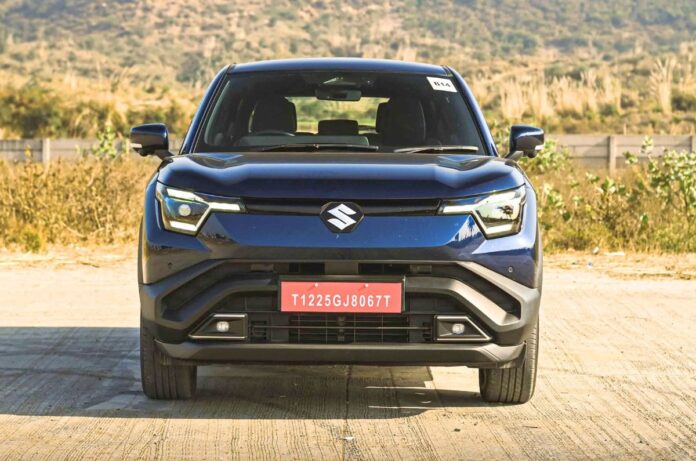

Maruti Suzuki has said supplies of its first electric SUV, the e Vitara, are likely to remain constrained in the near term, with production limitations expected to ease only after July. The company is currently balancing EV production with exports and strong demand for other models built on the same line.
-
e Vitara is built on a single Gujarat line alongside high-demand models
-
Export commitments add pressure on available production capacity
-
Supply situation expected to improve in the second half of FY2026
Speaking at a media roundtable, Partho Banerjee, Senior Executive Officer for Marketing and Sales, said the e Vitara is being produced on a shared line at Maruti’s Gujarat plant, which has an annual capacity of around 100,000 units.
Shared production line limits early volumes
The Gujarat line also manufactures other high-volume models, including the Fronx, which continues to see strong demand both in domestic and several export markets. Export commitments from the plant further add to the pressure on capacity.
“We have a line in Gujarat with capacity of one lakh units. But we have to cater to export demand, domestic demand and other models like the Fronx. So there will be some calibration till July,” Banerjee said.
Maruti has not disclosed how many units of the e Vitara are currently being produced or how much capacity will be freed up post-July.
Capacity expansion planned after July
Maruti plans to expand capacity on the Gujarat production line after July, which is expected to ease supply constraints and allow the company to scale up deliveries of the electric SUV in the second half of the fiscal year.
The company said it is working to ensure waiting periods remain manageable by carefully balancing domestic sales and exports.
Maruti evaluates EV demand with e Vitara

The e Vitara marks Maruti Suzuki’s entry into the electric vehicle space and will be produced for both Indian and overseas markets. While EV penetration in India has remained around 4-5 percent of passenger vehicle sales, Maruti expects adoption to improve as more models enter the market and charging infrastructure expands.