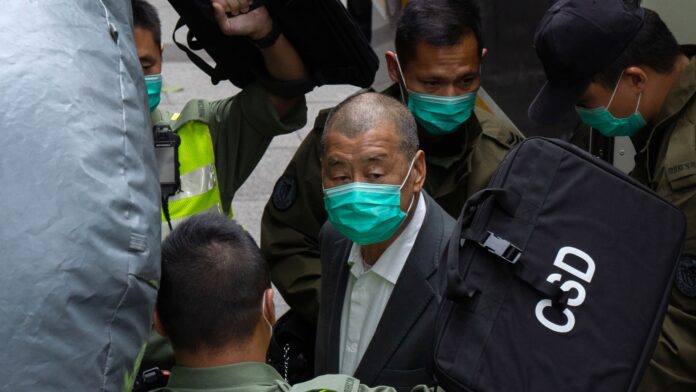

Jimmy Lai, founder of Next Digital Ltd., exits a Correctional Services Department vehicle as he arrives at the Court of Final Appeal for the verdict of his bail hearing in Hong Kong, China, on Tuesday, Feb. 9, 2021. Prosecutors in Hong Kong charged Lai, a prominent critic of Beijing and local authorities, last year under the national security law imposed by Beijing, saying he had colluded with foreigners by calling for sanctions against China. Photographer: Chan Long Hei/Bloomberg via Getty Images
Bloomberg | Bloomberg | Getty Images
Hong Kong pro-democracy activist and media baron Jimmy Lai on Monday was found guilty of collusion with foreign countries by a Hong Kong court, Reuters reported.
The 78-year-old was charged under Hong Kong’s controversial national security law, enacted by Beijing in 2020 after pro-democracy protests swept the region in 2019.
Lai, one of the Chinese Communist Party’s most vocal critics, had pleaded not guilty to two charges of colluding with foreign forces under the national security law, as well as a charge of conspiracy to publish seditious materials.
He has been under arrest since 2020, with his trial starting in December 2023.
The businessman, who founded Asian clothing brand Giordano, newspaper Apple Daily and digital media company Next Digital, was brought up by U.S. President Donald Trump during his meeting with Chinese President Xi Jinping in South Korea back in October.
Trump pressed Xi to release Lai during the meeting, according to Reuters.
The trial verdict is the latest development in Hong Kong’s political scene, which has seen the erosion of democratic opposition in one of Asia’s financial hub since the enactment of the national security law.
Under changes to Hong Kong’s electoral system in 2021, the number of directly elected members in the city’s legislature was drastically slashed, and only “patriots” reviewed by an election committee can stand for elections.
The verdict comes on the heels of the dissolution of Hong Kong’s last pro-democracy party on Sunday after 31 years, as well as a “patriots-only” legislative election that saw the second lowest turnout in the region’s history.
Speaking to CNBC before the verdict, veteran investor David Roche said that “If I were running Hong Kong, I know that I would have to convict the man, and I would then send him home, because then, in a sense, you put a full stop behind the political change in Hong Kong, but you do not create any further martyr.”
Lai acquired British citizenship before Hong Kong was handed back to China in 1997.
Roche added, “That, I think, would help to give the overriding impression and therefore conviction to people in the money business that Hong Kong had returned to its normal, business driven, dynamic self.”