
Yamaha’s history is a relentless pursuit of the “Kando”—the Japanese philosophy of simultaneous feelings of deep satisfaction and intense excitement. From the screaming two-strokes that dominated Grand Prix racing to the bulletproof reliability of their “Master of Torque” hyper-nakeds, the Iwata marque has always prioritized the soul of the machine over mere utility.
We have witnessed the Yamaha badge transformed into everything from minimalist cafe racers to dragsters that defy the laws of physics. Whether it’s the quirky backbone of a Virago or the legendary parallel twin of the XS650, these machines provide a foundation that supports even the most radical architectural leaps. Here are eight of the wildest, most expertly crafted Yamaha customs featured on Bike EXIF, selected for their audacity, engineering, and sheer visual impact.
The ‘Twinboss’ RXZ by FNG Works
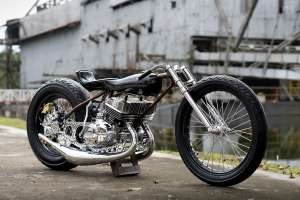
The Yamaha RXZ Twinboss is a motorcycle that shouldn’t exist, yet it looks like a factory prototype from a fever dream. Malaysian builder Irwann Cheng of FNG Works took two single-cylinder RXZ 135 engines and fused them side-by-side to create an inline 180-degree twin. It is a masterpiece of “what if” engineering, built on a shoestring budget by a man who sold his belongings to chase a dream at the Yokohama Hot Rod Custom Show.
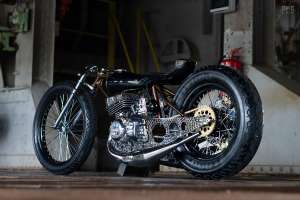
The chassis is a scratch-built dragster frame that utilizes the Golden Ratio and Fibonacci spirals to achieve eerie perfection in its proportions. Irwann spent months nerding out on the geometry, ensuring the distance between the wheels matched the height of the bike and the length of the tank. The frame’s neck features a unique cutout where the top yoke links to the steering stem, allowing the top tube to trace a perfectly straight line to the rear tire.
The engine is the real showstopper. The cases were split, welded, and massaged so expertly that judges initially thought it was a stock unit. Inside, the crankshafts were modified to work as a male-female couple. Finished in Chameleon Brown and black sparkle paint, the Twinboss is a testament to Irwann’s sacrifice and a masterclass in how mathematical precision can create mechanical beauty. [MORE]
The ‘Fujara’ Virago by Earth Motorcycles
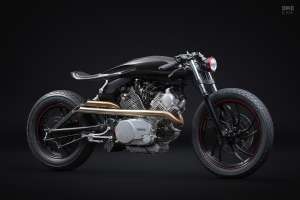
Making a “silk purse out of a sow’s ear” is the unofficial motto of anyone attempting to customize a Yamaha Virago. The Slovakian shop Earth Motorcycles bypassed the usual cafe racer tropes by focusing on the XV920’s most unique feature: its “levitating” engine. Founder Vlado Dinga worked with industrial designer Konstantin Laskov to create a silhouette that honors the three keywords of their design mantra: freedom, wind, and air.
The result is a monocoque fiberglass body that sits atop the engine like a single, tight curve. Developed using 3D rendering and a positive wood mold, the bodywork is incredibly svelte, featuring a flush-mounted gas cap and a recessed seat pad. By blacking out the frame and the boxy swingarm, Earth Motorcycles allowed the freshly rebuilt V-twin mill to shine as the undisputed centerpiece of the build.
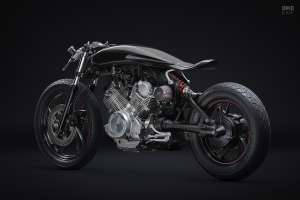
The bike is named “Fujara” after a traditional Slovakian shepherd’s flute, a nod to the straight, drag-style exhaust system that juxtaposes the curves of the body. Interestingly, Vlado chose to keep the OEM 80s alloy wheels, but with a twist—the inner ridges were milled out to clean up the design. It is a sophisticated, minimalist take on a donor bike that is usually anything but. [MORE]
The ‘Perseus’ XV1000 by CW Zon
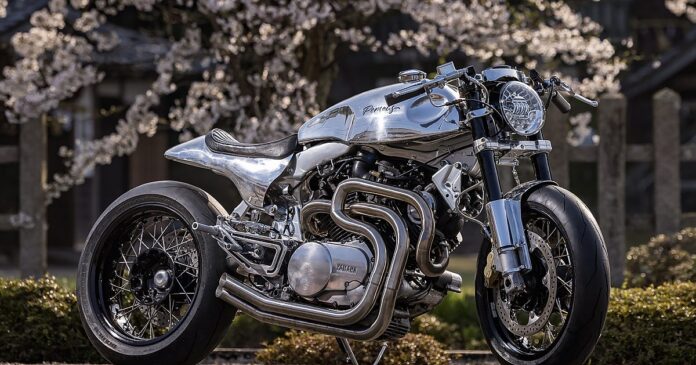
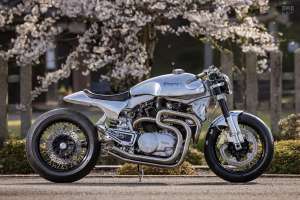
Yuichi Yoshizawa of CW Zon has a supernatural ability to peer into the “soul” of a mundane donor and set a masterpiece free. This 1981 Yamaha XV1000 (known to many as the Virago) is a far cry from the cruiser-adjacent oddball that left the factory. Yoshizawa-san has effectively split the build into two movements: a handcrafted, organic upper half and a high-performance overhaul of the running gear below.
The bodywork is a monocoque-inspired triumph, with a sculpted fuel tank that echoes the silhouettes of vintage Benelli and Norton Manx racers. It flows seamlessly into a modern tailpiece supported by a bespoke subframe and a pleated leather saddle. The finish is purely raw, eschewing paint for polished metal that highlights every hammer blow and weld, adorned only by the “Perseus” motifs—a nod to the Greek monster slayer.
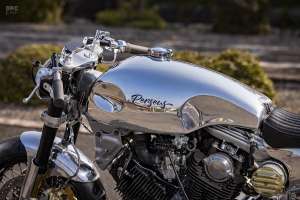
Underneath the skin is a mechanical cocktail. A single-sided swingarm from a Ducati Monster S4R was modified to fit the XV1000 frame, while the front end was beefed up with S4R upside-down forks. Laced 17-inch wheels from a BMW R nineT wrapped in Pirelli Supercorsa rubber ensure this isn’t just a showpiece; it’s a radical reimagining of Japanese engineering through a high-performance lens. [MORE]
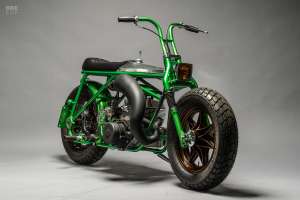
The ‘Green Monster’ Snowmobile-Bike by MotoRelic
Sean Skinner of MotoRelic is usually known for tidy restomods, but the “Green Monster” is a departure into the world of “overgrown mini-bikes.” The heart of this beast is a pull-start, two-stroke Yamaha SRV 540 snowmobile engine producing nearly 60 hp. Because snowmobiles use CVTs, Sean had to engineer a custom adapter to link the engine to a donated Harley-Davidson five-speed transmission via a belt drive.
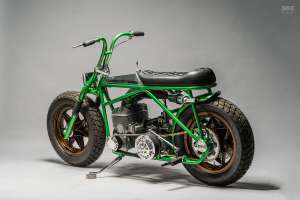
The frame is a TIG-welded masterpiece designed to look like a traditional friction-brake mini-bike, scaled up to terrifying proportions. The front end is equally creative, using narrowed and flipped forks from a Honda ATC200 three-wheeler. Sean devised a riser-less setup that threads directly into the fork tubes, maintaining the continuous “fork-to-handlebar” line that defines the mini-bike aesthetic.
Riding the Green Monster is described as “obnoxious on every level,” featuring heavy vibrations, open-primary dry clutch noises, and the characteristic crackle of a two-stroke expansion chamber. With its sparkly lime powder coating and 16-inch Henry Abe mags, it is a whimsical, slightly dangerous tribute to childhood nostalgia and pure mechanical audacity. [MORE]
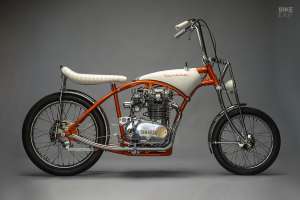
The ‘Orange Krate’ XS650 by MotoRelic
Before the Green Monster, Sean Skinner spent six years obsessing over a different kind of nostalgia: the Schwinn Stingray Orange Krate bicycle. He wanted to build a motorized, full-scale replica that retained the bicycle’s iconic “banana” silhouette. The project required Sean to teach himself how to roll steel tubing and build a complete frame from scratch, using PVC pipe as a prototype to nail the swooping curves.
The engine is an XS650 twin, re-phased to 277 degrees by Hugh’s Hand Built for a better firing order and smoother power. To replicate the Schwinn’s unique look, Sean built a “banana girder” front end from scratch, incorporating an adjustable mountain bike shock. He even fabricated a functional sissy bar with internal springs and bushings to mimic the bicycle’s seat suspension.
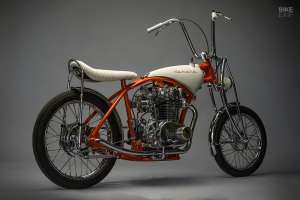
The finish is what truly sells the illusion. A heavy flake off-white paint on the tank, candy orange on the frame, and a white glitter vinyl seat create a retro-fabulous aesthetic. This isn’t just a motorcycle; it’s a piece of “art in motion” that captures the spirit of 1960s bicycle culture through the lens of a polished Japanese parallel twin. [MORE]
The ‘Manta’ XS650 by Baresteel Design
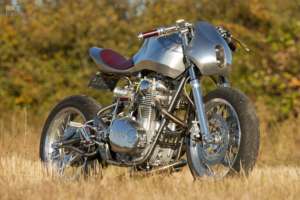
At just 23 years old, Jay Donovan of Baresteel Design was invited to the Sturgis Buffalo Chip’s “Motorcycles as Art” exhibition. With only ten weeks to the deadline, he transformed a 1979 XS650 into a fluid, aggressive machine inspired by the Giant Oceanic Manta Ray. Jay’s goal was to rework the Yamaha so heavily that the final product would appear to be a ground-up, scratch-built creation.
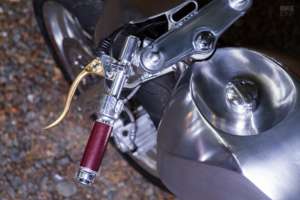
The chassis underwent a radical transformation, with the subframe replaced by a custom tail section set parallel to the engine fins. Jay converted the rear to a mono-shock setup using a Ducati Monster unit and modified the swingarm to accept a wider tire. The front end was swapped for Suzuki SV650 forks, lowered, and polished to match the brushed aluminum bodywork.
The “Manta” body was hand-formed from flat aluminum sheets using the classic Italian coach-building method of wire form bucks. The detailing is obsessive: every bolt head is smoothed and domed, hardware is cadmium plated, and leather accents are wrapped around the grips and kick-start. It is a stunning example of how a young builder can apply old-world techniques to a classic Japanese platform. [MORE]
The ‘Scheffersstyling’ GTS 1000
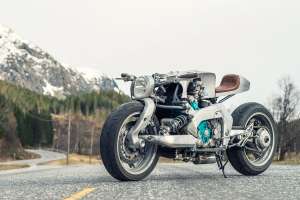
The Yamaha GTS 1000 is one of the most complex bikes in Yamaha’s history, famous for its hub-centered steering and “Omega” frame. Living near the Arctic Circle in Norway, Roel Scheffers decided to make it even more complicated. He grafted a Honda VFR 750 single-sided swingarm onto the rear to match the single-sided front end, then tucked a Buell “pull shock” underneath the engine to keep the profile low and clean.
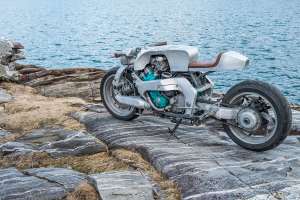
Roel didn’t stop at the suspension. He replaced the original fuel-injected motor with a 136-horsepower FZR1000 engine, fed by carbs with custom velocity stacks. To keep the bike’s height at a mere 32 inches, he had to relocate the radiator and oil cooler to the cramped spaces between the suspension arms and the frame. The front wheel is a “clever hybrid” of Honda NSR150 and VFR parts, requiring extensive milling and welding to function.
The result is a low-slung, stable machine that looks like it belongs in a sci-fi film. Despite the radical geometry and the “turning radius of a small truck,” Roel actually tours on the bike. It is a testament to the engineering possibilities hidden within Yamaha’s most experimental chassis, brought to life in a wood-paneled workshop in the Norwegian wilderness. [MORE]
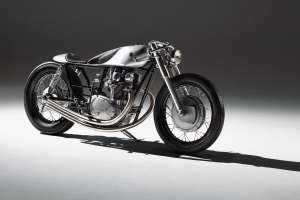
The ‘Type 6’ XS650 by Auto Fabrica
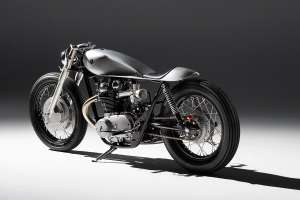
In the world of custom motorcycles, “simple” is often the hardest thing to achieve. Bujar Muharremi and the crew at Auto Fabrica applied the Japanese theory of Kanso, the elimination of clutter, to this XS650. The “Type 6” is an exercise in impeccable industrial design, where the tank and seat base form a single, elegant aluminum unit that flows from a lowered headstock to a minimalist rear cowl.
The engine was elevated through a single-carb conversion, with the intake and exhaust lines designed to create an asymmetric balance that tricks the eye. The stainless steel exhaust pipes are hand-bent into perfect, unmuffled-looking curves, though they contain hidden custom baffles for refined back pressure. Up front, a Laverda SF750 twin leading shoe hub provides a touch of vintage mechanical soul to an otherwise futuristic silhouette.
Auto Fabrica’s attention to “complexity in detail” is evident in the stainless steel fork covers and the slim clip-ons with inverted levers. The metal is finished with aqua blasting for a sophisticated matte look that rejects the “shouty” nature of chrome. The Type 6 isn’t just a custom Yamaha; it’s a refined piece of sculpture that epitomizes the “less but better” philosophy. [MORE]